HR AIVA
One platform for the whole employee lifecycle.
Most HR work happens outside the HR system.
Emails, spreadsheets, and WhatsApp groups are doing the heavy lifting. HR AIVA brings it all into one place.


No audit trail
Who approved this role, at what salary, and when — reconstructed from inboxes.


The record breaks at "hired"
Everything gathered during recruitment is stranded in the recruitment tool.


Scheduling is invisible
Nobody can answer 'is anyone covering Sunday night?' without asking someone.


Compliance is manual
Rest gaps, overtime and clearance checklists depend on somebody remembering.
Everything Your HR Team Needs
From hiring to exit, every workflow your HR team relies on — built into one platform with nothing they don't need.
Every stage from business case to exit in one connected record.
A living hierarchy from head office to individual positions.
Visual rotas with compliance checks built in — no more WhatsApp groups.
Configurable multi-step approvals with full audit trail.
Automatic ranking against role criteria with manipulation detection.
Candidates and employees complete tasks in their own space.
All Modules. One Record.
Each module feeds the next. Nothing is re-entered, nothing is lost.
Hiring
Business Cases
Prove the role is worth funding — before it exists.
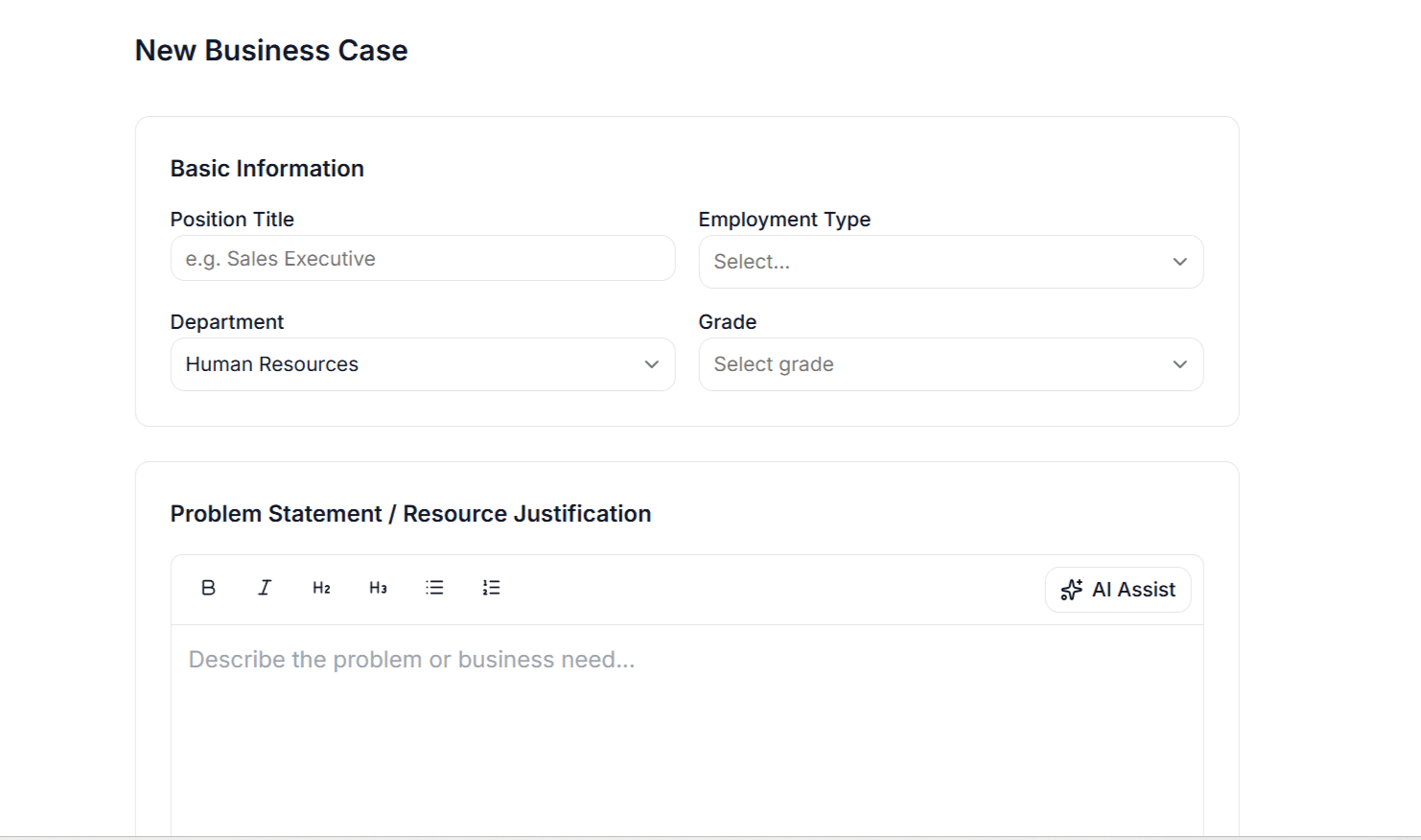
A business case carries the problem statement, the headcount per location and the cost, then walks a six-step approval chain in which only the Rewards team can touch the money.
Orientation & Onboarding
A first week that was actually planned.
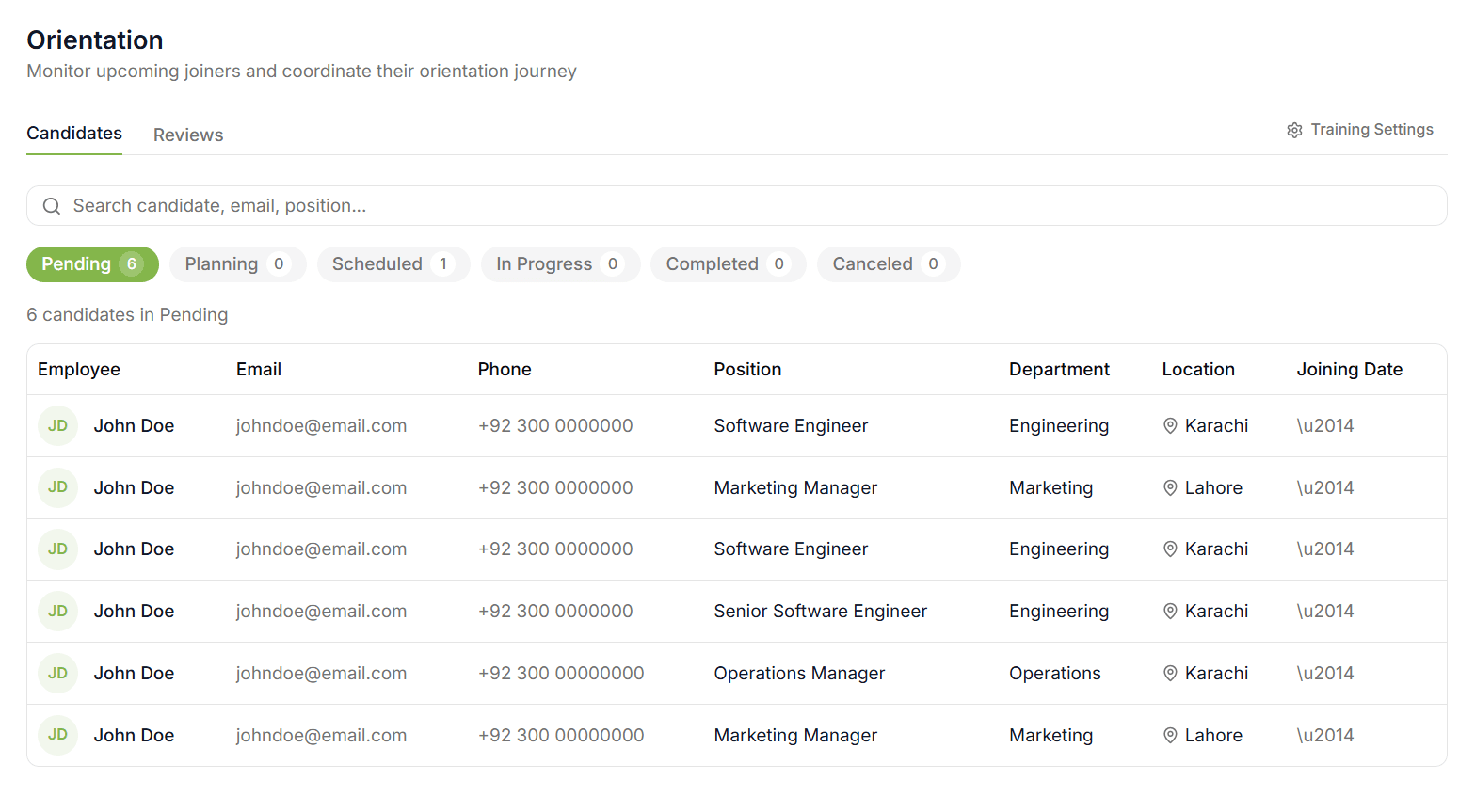
Each new joiner gets a line manager, a set of orientation sessions, and named people responsible for delivering them. Those people schedule their own slots, and the joiner rates each session afterwards.
- →Mandatory and optional training catalogues, configurable by HR
- →Line manager suggests sessions; stakeholders notified by email
- →Stakeholders pick their own slot and merge identical sessions across joiners
- →New joiner confirms attendance and rates each session on three measures
- →Employee details, equipment assignment, joining announcement to the team
Offboarding & Exit
Leaving is a process too.
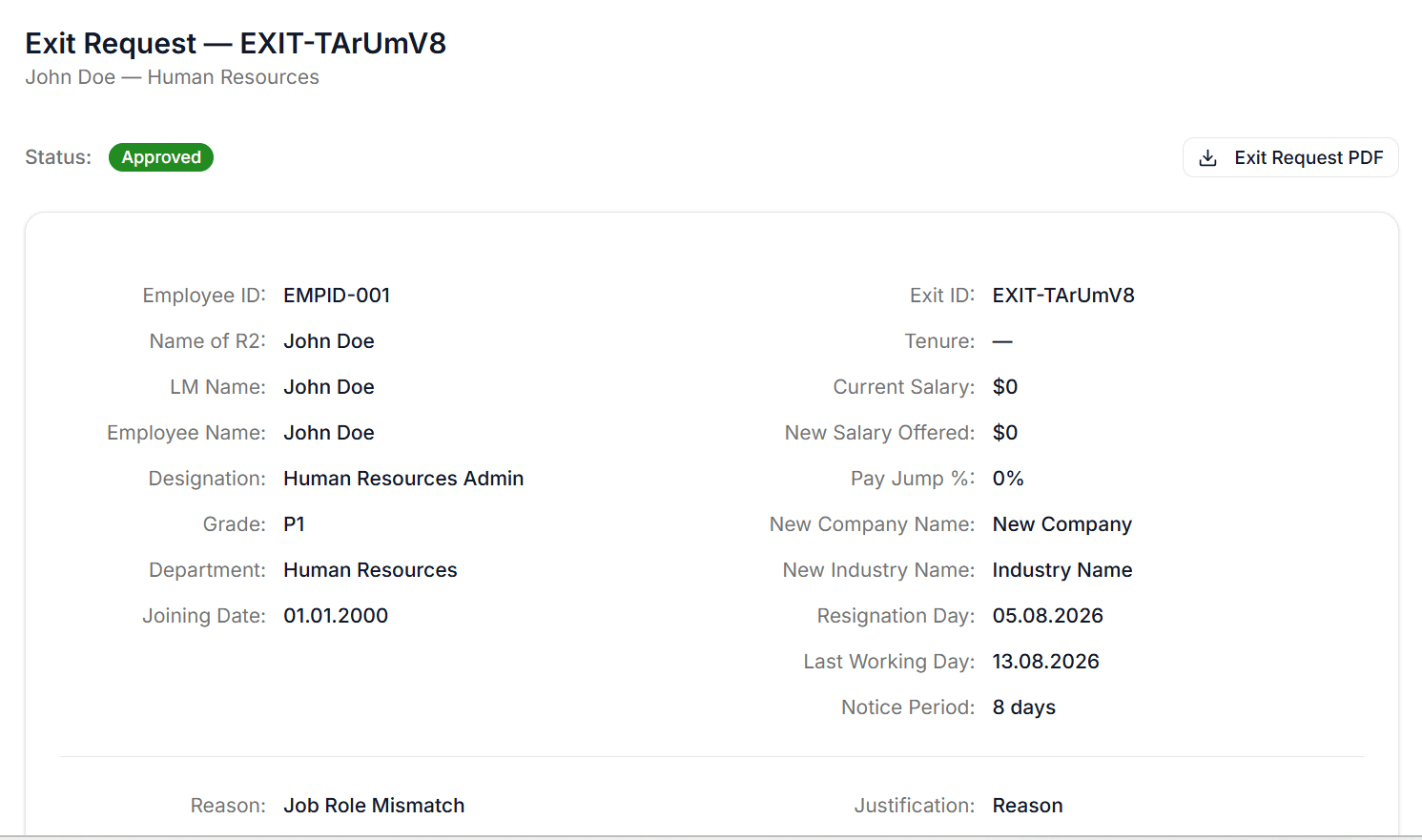
An employee raises their own resignation, or HR raises it for them. It routes through the line manager and HR, triggers a structured exit interview, and ends with departmental clearance.
- →Tenure, notice period and pay change calculated automatically
- →Withdraw at any point before final approval
- →Exit interview across culture, the job itself, and supervision
- →Clearance split by department, each section signed off by its owner
- →Exit form and interview responses exportable as PDF
Organization Structure
The org chart everyone asks for and nobody maintains.
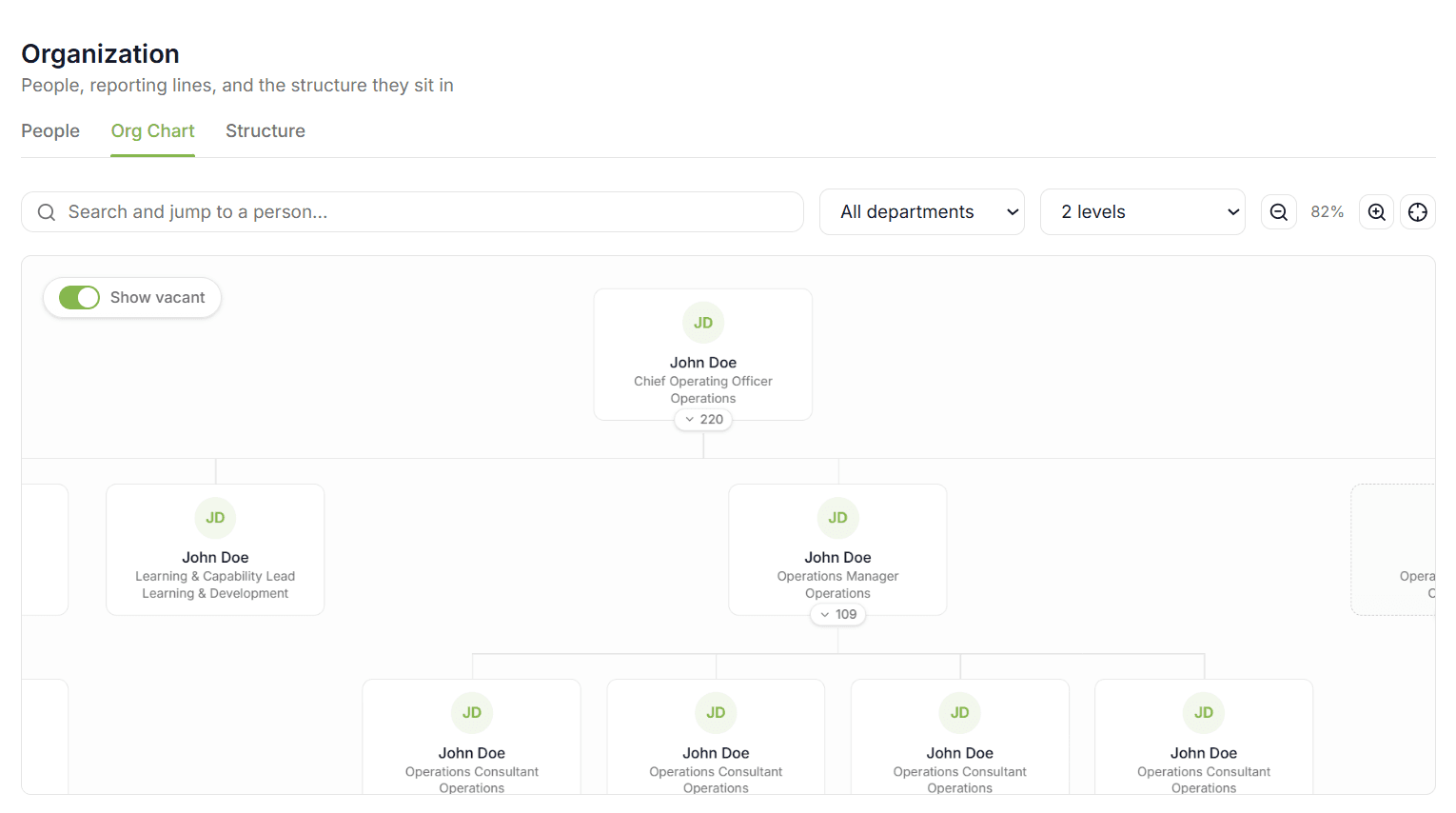
Regions, cities, restaurants and departments modelled as a real hierarchy — with every employee sitting in it. This is the backbone the rest of the platform hangs off.
- →Org units nested from head office down to individual restaurants
- →Searchable people directory with department and status filters
- →Interactive chart — drag to pan, scroll to zoom, collapse any branch
- →Vacant positions shown as open seats, so gaps are visible
- →One profile per person: personal, documents, compensation, hiring, training, exit
Headcount, filled positions and vacancies summed live. Search by name, employee ID or job title, filter by department, export the result.
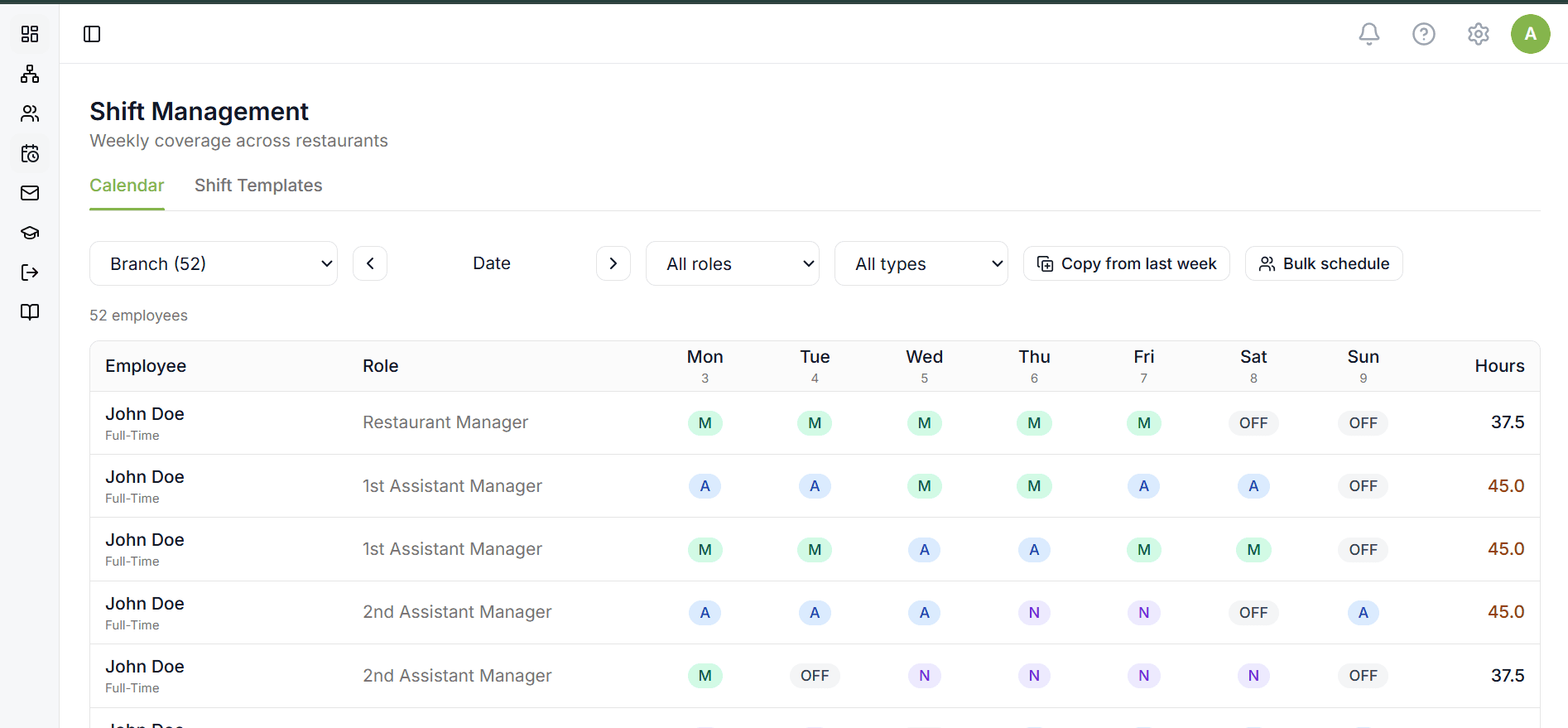
Shift Management
Replace the rota on the WhatsApp group.
A weekly grid per restaurant showing who works when. Coverage is summed as you edit, and the system flags the scheduling mistakes people make when they are tired.
- →Reusable shift templates with times, breaks and net hours
- →Assign a cell, a whole week per person, or copy last week wholesale
- →Per-shift coverage totals, colour-coded against the minimum
- →Weekly hours per person, flagged as they approach the cap
- →Employees see their own week in a read-only view
The approval chains are configuration, not code.
Stages, transitions and who may act at each one are stored as data. Every module inherits the same engine, the same permission model and the same audit trail.
Workflow Engine
Validates the actor's role, enforces required comments, records every transition.
Role-Based Access
Permissions stored per role and checked per action, not per screen.
Templates
Every email and offer letter editable, with variable substitution.
Notifications
Raised automatically to whoever is next to act.
Integrations
Common Questions
Hire better.
Manage smarter.
See how one platform replaces the spreadsheets, inboxes, and WhatsApp groups your HR team is running on today.